


[Column] Westerners and Shoes from a Cultural-Historical Perspective: “An Observation from 120 Years Ago” and a New Trend
2026.06.24

In my recent column, “The Japanese and Shoes: A Cultural-Historical Perspective,” I concluded by raising the following point:
“The culture of (leather) shoes that came from the West—and the new shoes that arrived, as if to signal a slight ‘return to the roots’—also came from the West.”
The leather shoes that entered Japan from the West during the late Edo and Meiji periods were initially something foreign that suddenly entered people’s lives as part of the government’s policy of Westernization.For the Japanese, who had been accustomed to open-toed footwear such as zori, geta, and setta, leather shoes were “cramped containers for the feet” and by no means comfortable.
Although leather shoes were worn primarily by the wealthy and military personnel at the time, it is believed that they became mainstream as “business shoes” as the population of office workers grew during the postwar period of rapid economic growth.Although manufacturing techniques and materials gradually evolved, dramatically improving comfort, the shape of leather shoes—with their high heels and narrow toes—which have been worn by countless people from the postwar era to the present, has undoubtedly had a significant impact on people’s feet.
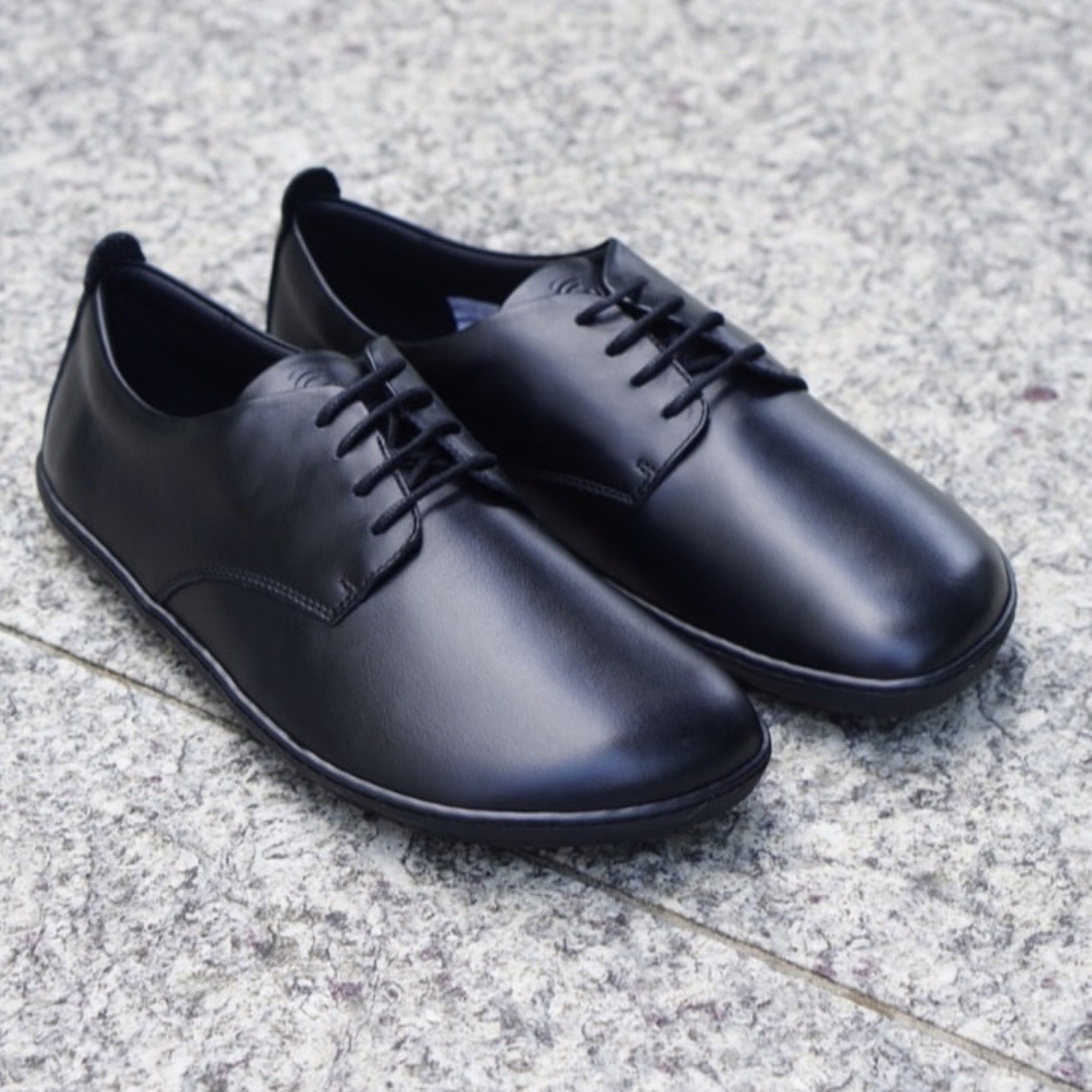
What’s interesting is that Europe—the birthplace of leather shoes and the source of their introduction to Japan—has also become a hub for reevaluating traditional shoe designs from a foot health perspective, particularly since the mid-2010s. Some brands even produce leather barefoot shoes.Among the brands currently carried by STRIDE LAB are SKINNERS, GROUNDIES, and BLUSUN—which we mentioned in our previous post.
For Japan, these are “(leather) shoes that came from the West and returned to the West.” In this post, I’d like to reflect on these shoes—which have arrived in Japan in various forms, both in the past and present.
Shoes so “tall” and “long” that they make you fall over
The history of leather shoe making in Europe dates back to the Middle Ages; however, since there was no established production system for leather shoes as an industry at that time, it is said that only a very limited number of people—royalty, nobility, and wealthy merchants—wore shoes as fashion items.A representative example is the “Krakow,” which originated during the Gothic period (approximately the 12th to 15th centuries). It is said to have originated in Poland and was named after “Kraków,” the capital at the time. In France, the same shoe was called a “pouline.”
These shoes had long, slender, upturned toes, and it is said that at their longest, they measured anywhere from 14 inches (about 35 centimeters) to as much as 1 meter. Since the toes were sometimes even tied to the wearer’s knees to prevent tripping, they had absolutely no practical functionality as footwear; rather, leather shoes were likely viewed solely as luxury items and status symbols.
Among women, high-soled shoes (thick-soled shoes) became fashionable. Also known as platform shoes, these were shoes in which the entire shoe—from toe to heel—was raised on a platform or similar base. Heeled shoes did not become popular until a later era. They were popular among both men and women, and unlike the “Krakow,” there were functional reasons behind this trend.At the time, city streets lacked any concept of public health and had no sewage treatment facilities, so trash and all sorts of other debris were scattered across the roads; these shoes were a way to keep one’s feet clean. At the same time, since only the wealthy could afford such shoes, they also served as a symbol of social status.
However, the heels on these shoes could be as high as 30 centimeters at their highest, and it seems there was a high risk of falling immediately without assistance. The heel components were also made of wood, making it difficult to distribute body weight evenly, so the design could hardly be described as ergonomically sound.
It is said that leather shoes in a form similar to what we see today began to circulate in Europe around the mid-19th century. This was made possible by the advent of mass production via machinery. Since leather shoes were introduced to Japan during the late Edo period and the Meiji era, the establishment of the modern leather shoe style in Europe and its arrival in Japan occurred at roughly the same time historically.
Trends and Reason
There is a paper published in 1905, about half a century after mass production of leather shoes had been established in Europe.
Dr. Phil Hoffman, an American orthopedic surgeon, observed the feet of 186 people who had never worn shoes and compared them with those of people who wore shoes on a daily basis, examining the condition of their arches and their gait patterns.
He pointed out that in the group accustomed to wearing shoes, the forefoot had narrowed (resulting in bunions or hammertoes), and there was a reduction in the range of motion of the toes and ankles. He concluded by stating, “The last used to shape ‘civilized’ shoes does not follow the contours of a normal foot.”
“Civilized shoes” are thought to refer to leather shoes with narrow toes and high heels; the shape of such shoes was gradually determined by cultural factors such as fashion trends, leading to the establishment of last designs and production systems, and ultimately their widespread distribution.
Hoffman also writes that “fashion exerts a stronger influence than reason,” and it may be that this gradual process of determination slowly brought about physical and psychological effects on individuals as well. This gradual trend reportedly continued unabated even after he raised these concerns.
Landing Again Two Centuries Later
It has been just under two centuries since the standard production system for leather shoes was established in Europe in the mid-19th century. Now, in the 21st century, a wave of redesigns is sweeping through the world of leather shoes.
Traditional leather shoe manufacturers have likely pursued comfort and design while maintaining last shapes with high heels and narrow toes. Business shoes continue to be worn precisely because, as the name suggests, they are suited for formal occasions, and it is also true that the diversity of their designs reflects a rich history from the perspectives of fashion culture and craftsmanship.
That said, it is precisely for this reason that brands like SKINNERS (2014–), GROUNDIES (2019–), and BLUSUN (2024–)—which I highlighted at the beginning—have been able to create leather shoes that conform to the natural shape of the foot.Rather than a rebellion against traditional values, this may simply reflect an increase in options; one could even say that the issue raised by Mr. Hoffman 120 years ago has finally taken shape.
In fact, at the very end of the conclusion of the aforementioned paper, there is a reference to the Japanese, who are cited as an example of a group that does not constrict the spread of the toes.Although Western-style leather shoes had undoubtedly made their way into Japan by 1905, “footwear” such as zori was still the norm for the majority of Japanese people; thus, the paper refers to them as “modern sandal-wearers.”
Historically, until very recently, the Japanese basically lived barefoot. More than 120 years have passed since then. There is a certain irony in the fact that leather shoes redesigned for barefoot wear are once again coming in from Europe, and isn’t this an interesting development when considering the history of footwear?
Reference)
Minoru Inagawa, Yoshimi Yamamoto. A Cultural History of Shoemaking: Japanese Shoes and Artisans, Gendai Shokan, 2011, 245 pp.
PHIL HOFFMAN. “CONCLUSIONS DRAWN FROM A COMPARATIVE STUDY OF THE FEET OF BAREFOOTED AND SHOE-WEARING PEOPLES,” The Journal of Bone and Joint Surgery, 1905, s2-3:105-136