




While an appealing brand and excellent products are essential, building a strong organization is also indispensable for a company’s growth. Tomonori Hasebe oversees STRIDE’s back office and is energetically driving this organizational development forward. We trace his journey—from joining the company as an accountant to continuously taking on the challenges that came his way.
Text by Toshiaki Ito
Photos by Shinichi Yajima

From “Math for Liberal Arts Majors” to Stride
Tomonori Hasebe built Stride’s back-office operations. While his current main responsibilities include accounting, general affairs, and human resources, as the business continues to expand, he will also be tasked with building the organizational foundation that supports that growth. His previous job was as a staff member at a tax accounting firm.When I heard that he had been aiming to become a certified public tax accountant since entering college, I couldn’t help but ask, “Why?” It just didn’t seem like the kind of career an 18-year-old would be interested in.
The story goes back to the time of his college entrance exams.
He spent most of his high school years just having fun, and didn’t start thinking seriously about college entrance exams until the fall of his senior year—which was quite late. Although he was in the humanities track, he was hopelessly bad at social studies subjects. While researching whether it was still possible to catch up, he discovered a “math-based entrance exam” track where applicants could choose math as their third subject. He was relatively good at math. Thinking, “There probably won’t be much competition here,” he looked for universities that accepted this track and found that almost all of them were economics departments.
For the next three months, I studied like my life depended on it. Believing that “entrance exams are all about patterns—you can beat them just by mastering patterns,” I didn’t attend any cram school and instead focused exclusively on past exam questions from the university I wanted to attend. He says he would never have been accepted at any other university, but he still managed to slip into his first-choice school.
Not only were the timing of his exam preparation and his study methods unconventional, but I was also surprised to hear that by the time he entered college, he was already looking ahead to his career.
“I could vaguely see a path called ‘humanities math,’ and I thought to myself, ‘This is probably the only path for me.’Since I was only 18, I felt—without any real basis—that my possibilities were endless. So I decided, ‘If that’s the case, I’ll aim for the top.’”
When I looked into the top career path in “humanities math”—that is, the field of economics and business—I found it was the Certified Public Accountant (CPA). It’s one of the three major national certifications, alongside doctors and lawyers. However, when I looked into the actual job duties, I felt it might not suit my personality.
“So, when I started thinking I’d prefer a job that was a bit more people-oriented, the role of tax accountant came to mind. It involves listening to the concerns of small and medium-sized businesses, offering advice, and providing accounting support. I thought, ‘This is the direction I want to go.’”

That’s how I felt when I entered college, and I chose my classes based on whether they would “help me get a job.” During my job hunt, I narrowed my focus to four tax accounting firms, but I received a job offer from the first one I interviewed with. Since the workplace atmosphere was good, I decided to accept the position right away. I didn’t even apply to the other three firms.
So I joined that tax accounting firm, but the work was tough. I was assigned a workload that I didn’t think a junior employee could handle. Even so, I resolved to “stick with it for three years” and hung in there.
“I used to think there was no basis for the saying I’d heard somewhere—‘It’s meaningless unless you stick with it for three years’—but once three years actually passed, things started to become a little clearer.I learned how to pace myself, and I started being able to talk with clients in a more relaxed and natural way, which made things easier. I began wanting to hone those skills a bit more, so I ended up staying there for about six years.”
After six years, I had become a solid mid-level employee. I even had junior colleagues of my own.I had become completely accustomed to the work. Even so, I was extremely busy. By that time, I was handling more than 60 companies on my own. I felt both that I was “still inexperienced” and that I wanted to “put these skills to the test,” but the thought of changing jobs began to take root. Combined with changes in my personal circumstances, I decided that now was the time to make a move.
Just as Hasebe was about to make the move, Stride was looking for an accounting specialist. As the company grew and its workforce expanded, they were aiming to handle accounting in-house.
Don't let the ball float in the air
And so, as the timing aligned, Hasebe joined Stride. He started as an accounting clerk, but as the company grew, he began taking on responsibilities in human resources and recruitment as well.
It all began with a simple question that popped into his head one day while he was processing payroll: “What are the salary levels like at this company, anyway?”Upon investigating, he discovered that salaries weren’t being adjusted at set intervals. There were no clear criteria either—a common occurrence in small companies.
“But when I considered that this was a company poised for growth, I realized that unless we recognized and rewarded those who understood the company’s vision and worked hard—regardless of their distance from headquarters or year of hire—our corporate culture wouldn’t take root,”
I proposed establishing an evaluation system for the company. We would create evaluation criteria and a review period to determine whether to grant a raise—and if so, by how much.
“I proposed that if we could do that, even as the workforce grew and there were people I couldn’t directly oversee, we could still evaluate them by having their immediate supervisors report back to me. That way, it would work even if the company grew to hundreds of employees,” I explained.
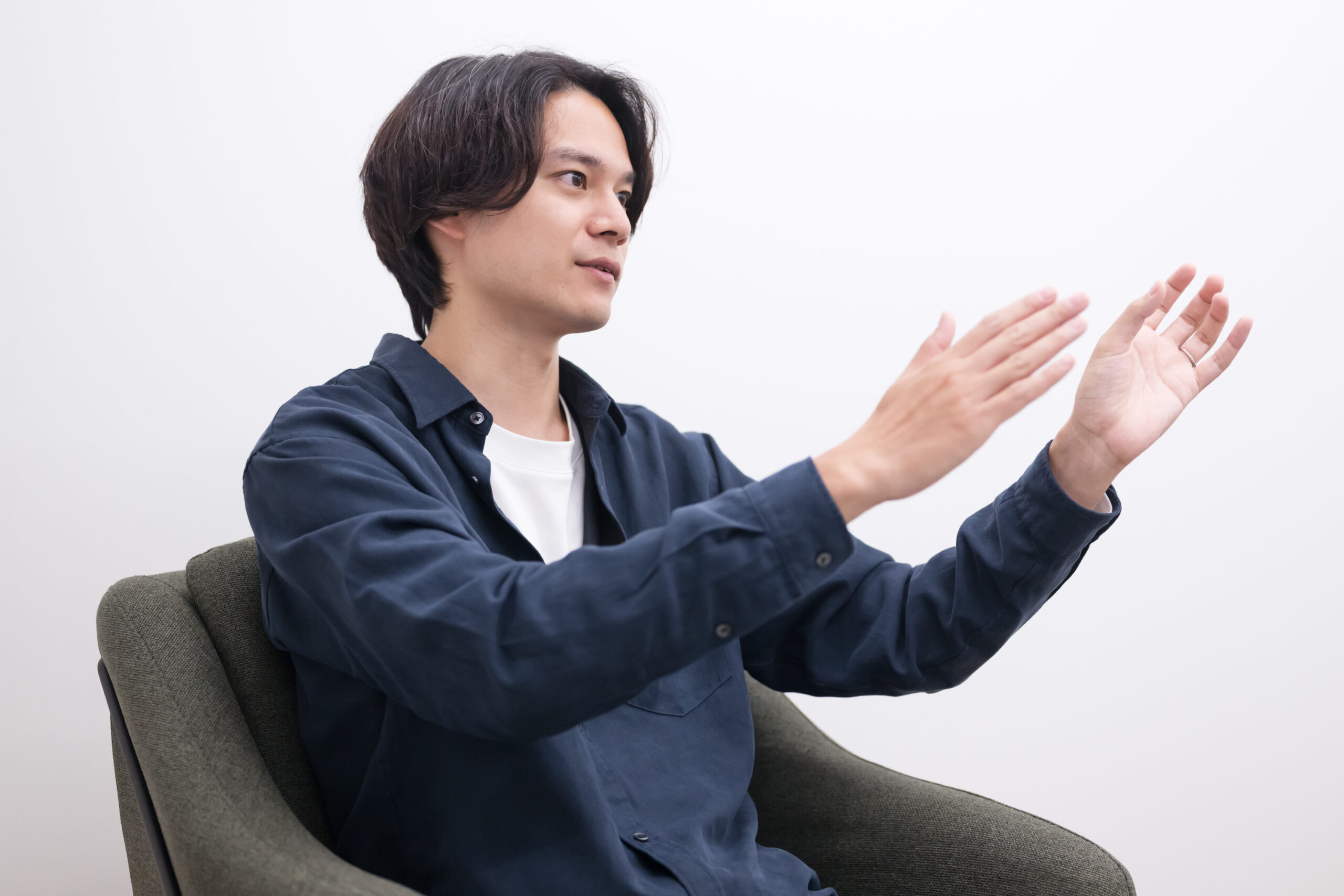
Hasebe’s proposal was approved, and an internal evaluation system was established. The next question—“Who will be in charge?”—went without saying.
“Since I was the only one working in the administrative office, when the question came up, ‘Who’s going to do this?,’ everyone immediately thought, ‘It’ll probably be him’ (laughs).But by that point, I wasn’t hesitant anymore. There was no point in shying away or dithering, so I said, ‘I’ll do it, so let’s move forward.’ Before I knew it, I was managing the entire Corporate Division, including General Affairs.”
It sounds like a natural progression, but it also seems like I was stepping into the fire.“Why?” I ask again.
“The future this company is aiming for—‘Every Step Toward Health’—is appealing to me, too. The president’s way of thinking is exciting, too, when I listen to him. When I was first considering changing jobs, I thought I could do accounting anywhere, but the reason I wanted to work here was because of that appeal.Now that I’m here, I want to help realize what the company is striving for, and to achieve that, I have to do something within the scope of what I can see. I was the only one who could tackle that challenge.”
Like every Stride staff member I’ve spoken with so far, Hasebe, too, appears cool on the surface but harbors a passionate fire within.
“We’re a company with few rules, but we don’t let loose balls or unfinished tasks go unattended. Someone always steps in to handle them. I think that’s important, so if I see a ball within my reach, I grab it right away. I felt this was something I needed to do.”

The department is called the “Corporate Division,” rather than General Affairs or Human Resources. While its primary responsibilities include accounting, general affairs, and human resources, as the company grows, it will also take the lead in organizational development and legal affairs in a broader sense. The structure to support this transition has gradually taken shape. Until the beginning of this year, I was the only person in the department, but now there are four members.
“Since our team has grown recently, I’ve been able to delegate more responsibilities. While managing the team, this department handles both day-to-day tasks and what I’d call ‘mission-critical’ work. This involves creating the systems and organizational structures that become necessary as the company grows. We set goals like ‘implement this system by such-and-such a date’ and work to make them a reality and ensure they run smoothly.I think about what’s needed to achieve that, and then put it into action.”
As the company grows, it requires the right quality and quantity of talent, as well as the right organizational structure to support that growth. Furthermore, it becomes necessary to establish the detailed rules that go along with it. Even while sitting at my computer handling daily tasks, I’m constantly thinking about these things, even when I step away from my desk.
A workaholic? No—I think this is simply what happens naturally when people find a place where their work is truly fulfilling.


Profile
Tomonori Hasebe
Born in Tokyo. He played soccer as a kid through elementary and middle school, but was timid and always kept an eye on his surroundings, playing a style of soccer designed to “avoid getting scolded.” He believes his tendency to anticipate loose balls and act proactively was likely cultivated during that time.His hobbies are horse racing and beer. He got hooked on horse racing after losing a bet on the Arima Kinen—a race he’d tried just for fun—and feeling so frustrated that he looked up the horse’s pedigree. Now, he looks forward to finding his favorite horse in the maiden races at the end of summer.